

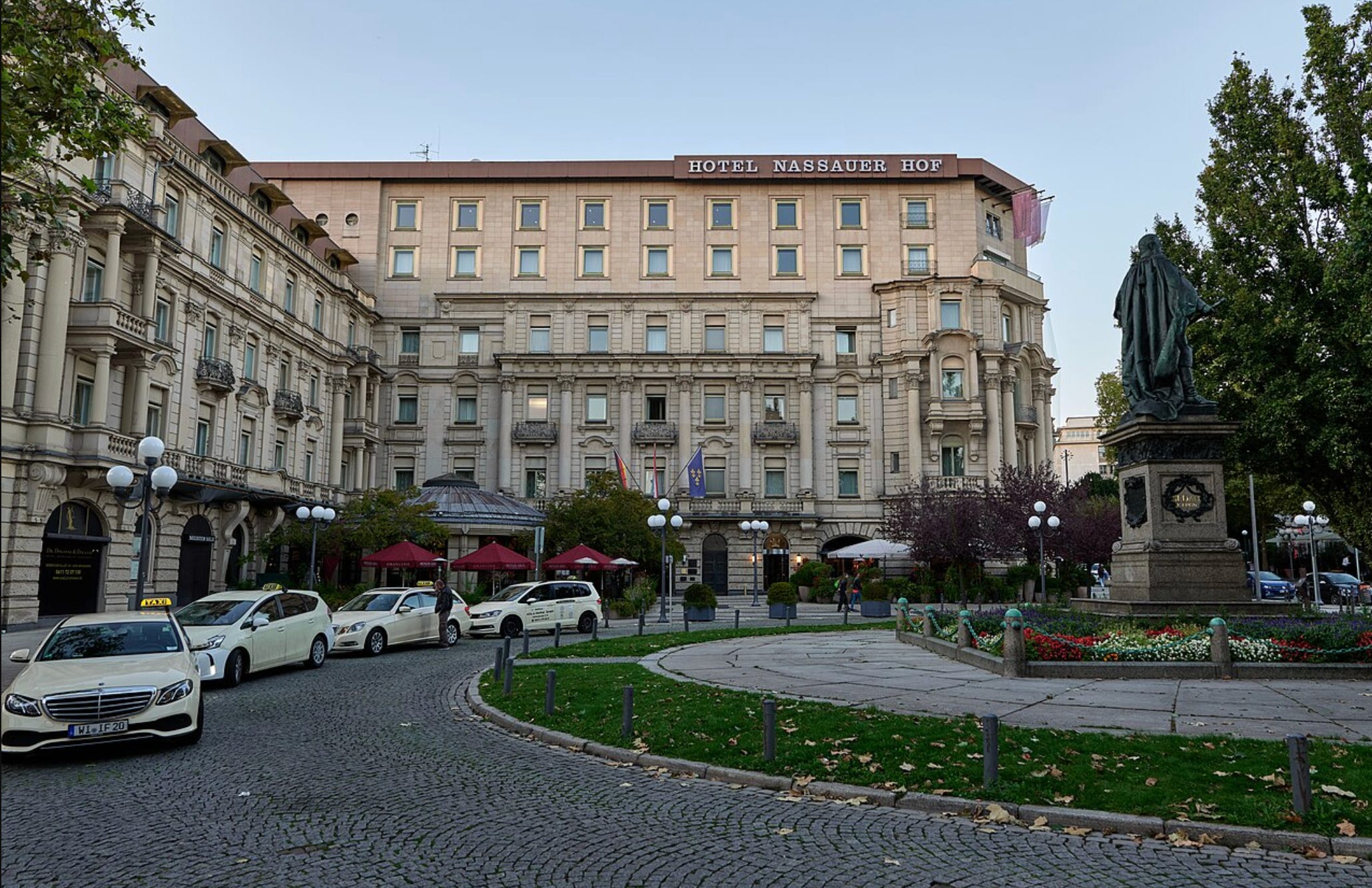
There was a hallway in Wiesbaden’s Nassauer Hof I loved for its absurdly specific reason.
It was as wide as a Texas Interstate.
And not in a modern, Marriott-y way. This hotel runway came from another time and civilization, designed to be broad enough for two women in the flowing dresses of Imperial Germany to swish past one another without their skirts touching.
Whether that was historical truth really doesn’t matter. That hallway in the Nassauer Hof made you believe it.
So did the stained-glass portraits of the jolly Germans on the landing, and the enormous buttons on the doormen’s tunics. The upholstered furniture and the formal friendliness of the staff and in the lobby, the mother-daughter combo in matching cashmere. The place seemed poised to welcome back a half-peck of Hohenzollerns at any moment.
Now the lobby is empty.
First opened in 1813, Nassauer Hof closed at the beginning of 2026 for the most extensive renovation in its long and storied history. When it returns—currently expected around 2028, but you know hotel openings—it will have fewer but larger rooms, a rebuilt thermal spa, a new courtyard, bar and if the rumors become reality, a glass cupola resurrected from its past.
But I really hope they don’t narrow the hallway.
Because the old pile is more than a grand hotel. It’s a symbol of a particular kind of European city we 21st Century travelers, aside from Wes Anderson, had almost forgotten: the spa town.
And Wiesbaden has been one for roughly two thousand years.
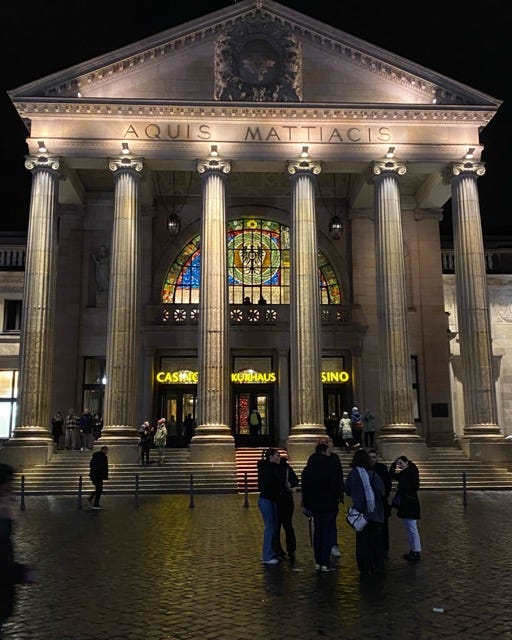
The Romans knew the place a “Aquae Mattiacorum,” the waters of the Mattiaci. Today 26 thermal springs gurgle up two million litres of mineral water every day. The hottest reaches about 67 degrees Celsius (that’s 150 scalding degrees in American). Walk around and the old town center. The city is one-part real estate, one part geology.
Across the Bowling Green was where Dostoyevsky famously gambled away his travel money in 1865, an experience that helped feed his book The Gambler. Hotel legend says that he stayed at the Nassauer Hof and departed without settling his bill. Other accounts say he couldn’t afford the rates, so he was never there at all. As a writer I find the latter option the likeliest.
So what? Every proper grand hotel eventually acquires stories about guests it can’t quite find the registration cards for.
By the 19th Century Wiesbaden had turned its hot water into an industry and elaborate social ritual. Aristocrats, invalids, artists, industrialists and assorted titled heads came to bathe, promenade, seduce and gamble.
Nassauer Hof became their boarding house.
Kaiser Wilhelm II stayed here. Tsar Nicholas II, too. The two met there in 1903. Later came Audrey Hepburn, the Dalai Lama and enough famous names to fill the leather-bound guest books at reception.
The casino still stands in the Kurhaus across the Bowling green. The roulette wheel associated with Dostoyevsky is still there, too. When I stayed at the Nassauer Hof, I could see the casino from my room meaning the geography of the story required almost no imagination on my part: hotel, green, casino. Bed, bet, ruination.
The other thing beneath the Nassauer Hof is water.
The place has its own thermal spring, which fed the swimming pool high in the building. There’s something wonderfully Wiesbaden about swimming above the rooftops in water pumped from its basement. That’s a link the hotel owners say they want to keep.
I hope so. That and the old school Mercedes taxis hanging out on the street.
ENTE, the hotel’s celebrated restaurant, has held a Michelin star continuously since 1979. When the Nassauer Hof closed, chef Michael Kammermeier and his team didn’t disappear onto a cooking show. They packed up and moved to the gatehouse of Kloster Eberbach, a 12-Century Cistercian monastery in the Rheingau where they filmed The Name of the Rose.
That’s a spa town for you. Even a culinary icon can find temporary digs in an 800-year-old landmark.
There are towns where all this history w=could become suffocating. Wiesbaden somehow wears it lightly. Maybe its because the city understands, and has always understood, the past is most useful when you can gamble with it, sip it from a glass or simply soak in it—mineral baths or otherwise
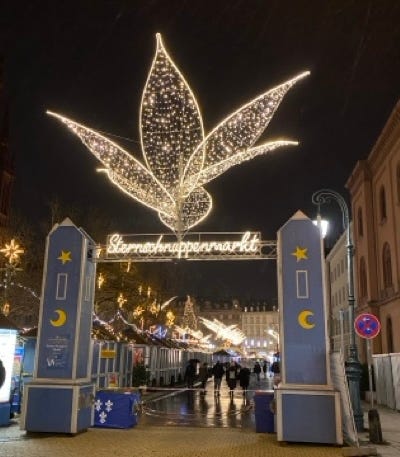
My favorite time to visit is at Christmas, when the town’s center filled with lights and the Sternschnuppenmarkt, the Shooting Star market, twinkles through the squares around the Marktkirche. There are handmade ornaments, hot food, mulled wine, much hilarity and, after more mulled wine, the idea that standing outside in the frigid damp is the most natural thing in the world.
And that could be why I’m not alarmed about the Nassauer’s being rebooted from its elevator shafts up. It’s a makeover for a new century. The 159 rooms will become 104; the thermal bathing will be rethought and the old facade restored. There are rumors a once extant glass cupola will return to crown the rooftop.
So we’ll see what happens. It’s scheduled to open in 2028. But that’s hotel PR time, you may need to add some months. Meantime should you find yourself in this German spa town here are five things to see and do:
Kaiser-Freidrich-Therme. Take the waters in a wonderfully old-fashioned bubbly bathing complex that lets you imagine yourself a St. Petersburg count or Toledo paperclip manufacturer floating in tiled pools or wandering Art Nouveau interiors making wellness feel like your civic duty. Opened in 1913 downtown, on the site of an old Roman bath, it’s proof Wiesbaden has gotten wet for a very long time.
Walk the Bowling Green to the Kurhaus. The great sweep of lawn outside the Nassauer Hof leads straight to Wiesbaden’s neoclassical casino. The Kurhaus is all columns and Imperial German self-confidence. Inside Dostoyevsky lost his shirt. Don’t lose yours.
Poke around the Kochbrunnen. This is where Wiesbaden’s most famous spring bubbles forth hot and smelling like minerals. You can see it emerge inside a pretty 1887 pavilion. It’s the earth perspiring. The surrounding streets, lined with good 19th century German architecture and cafes, is where hydrology meets gentility and a good place to stroll.
Take the Nerobergbahn. The little yellow-and-blue 1888 funicular clambers up the steep side of the Neroberg, a hill and tourist attraction since the 19th century. Arriving at the summit you will wander the woods until you come across the 1850s Russian Orthodox church with a Taj Mahal-sized tragedy. It’s a memorial to a a young Romanov bride. The Russian aristocrat Grand Duchess Elizabeth, 18, and her newborn daughter. Both died during the birth. Her grief-stricken husband built the church as her memorial. It’s a focal point for the Russian community. The place could be a plot point for a John le Carré Cold War yarn.
Spend an evening in vineyards. Wiesbaden sits at the gateway to the Rheingau, one of Germany’s great wine regions, where the Reisling wineries roll across the Rhine hills towards Eltsville and Rũdesheim. Go to Koster Eberbach, the medieval abbey, for a dinner at ENTE, the Nassauer Hof’s relocated Michelin-rated restaurant.
Try anther wine town:
A Napa that isn’t pretentious
And for another great European hotel:
An Irish estate called Ballyfin
###
NOTE: I use AI like I might use a good research assistant and copy editor—if I could afford them—to chase down references and links, flag things worth checking, and find errors, grammatical mistakes and clumsy prose. I verify the facts and print corrections when wrong. The ideas, words, observations and opinions are my own.
two thousand years of people travelling for water and stillness, and now we call it wellness programming. The spa town never went out of style, we just forgot to sell it.