
Over There
For Americans, Europe's becoming a theme park. Here are a few ideas on how to leave the lines behind.

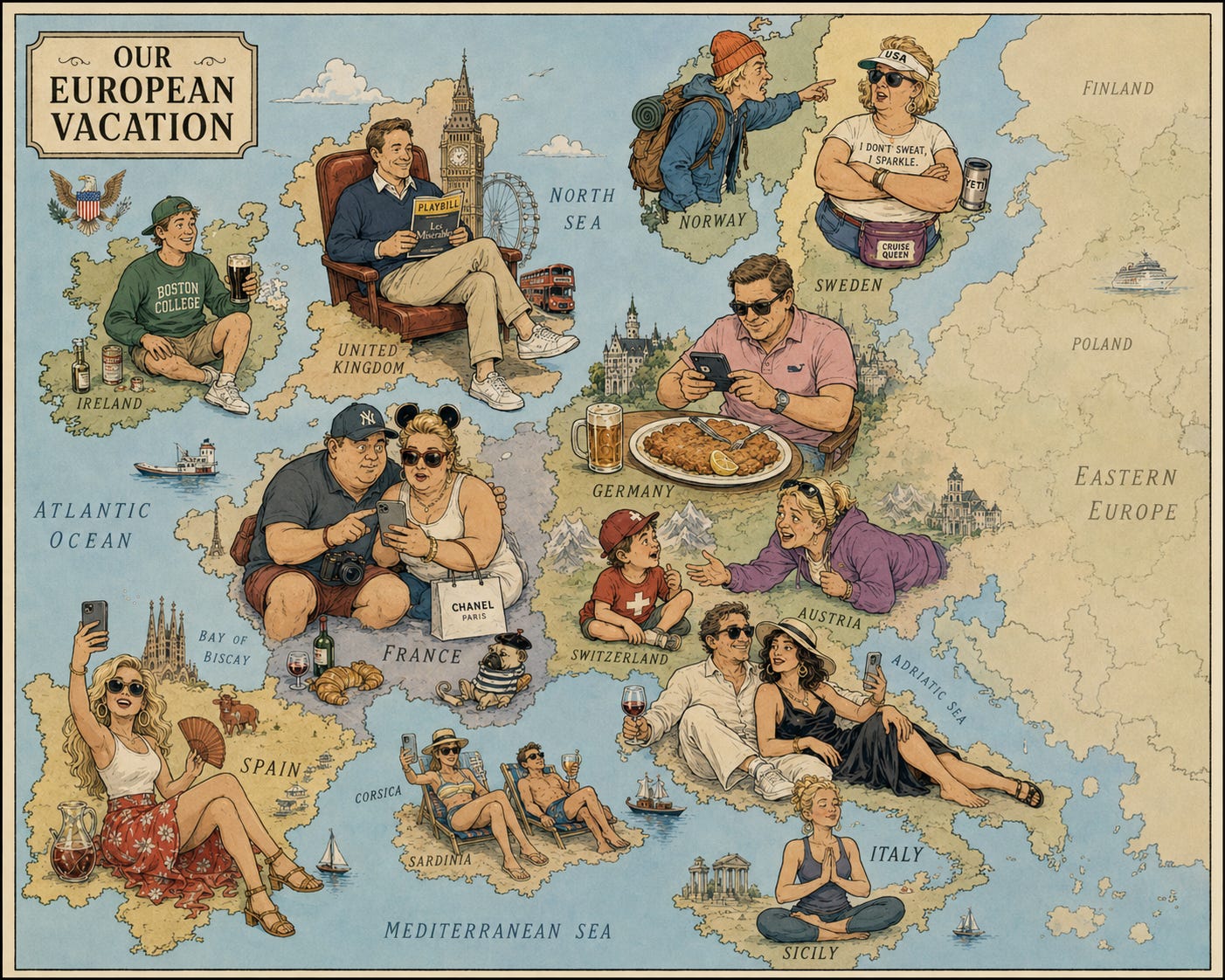
I returned from Europe two weeks ago, and if you’re headed there this summer I’m afraid you’re going to have to work a little harder to connect with the Old World. To borrow an old British complaint about American GIs during World War II, we're “overpaid, oversexed, and over here.” So much so I fear your vacation won’t be so much Emily in Paris as Emily in Paris, Texas.
This HOKA-shod invasion force has been assembling for a long time. Last year it stormed Cap d’Antibes. The year before Positano. This summer it’s Albania. Albania! But for me it all got real when Rome started charging admission to a fountain.
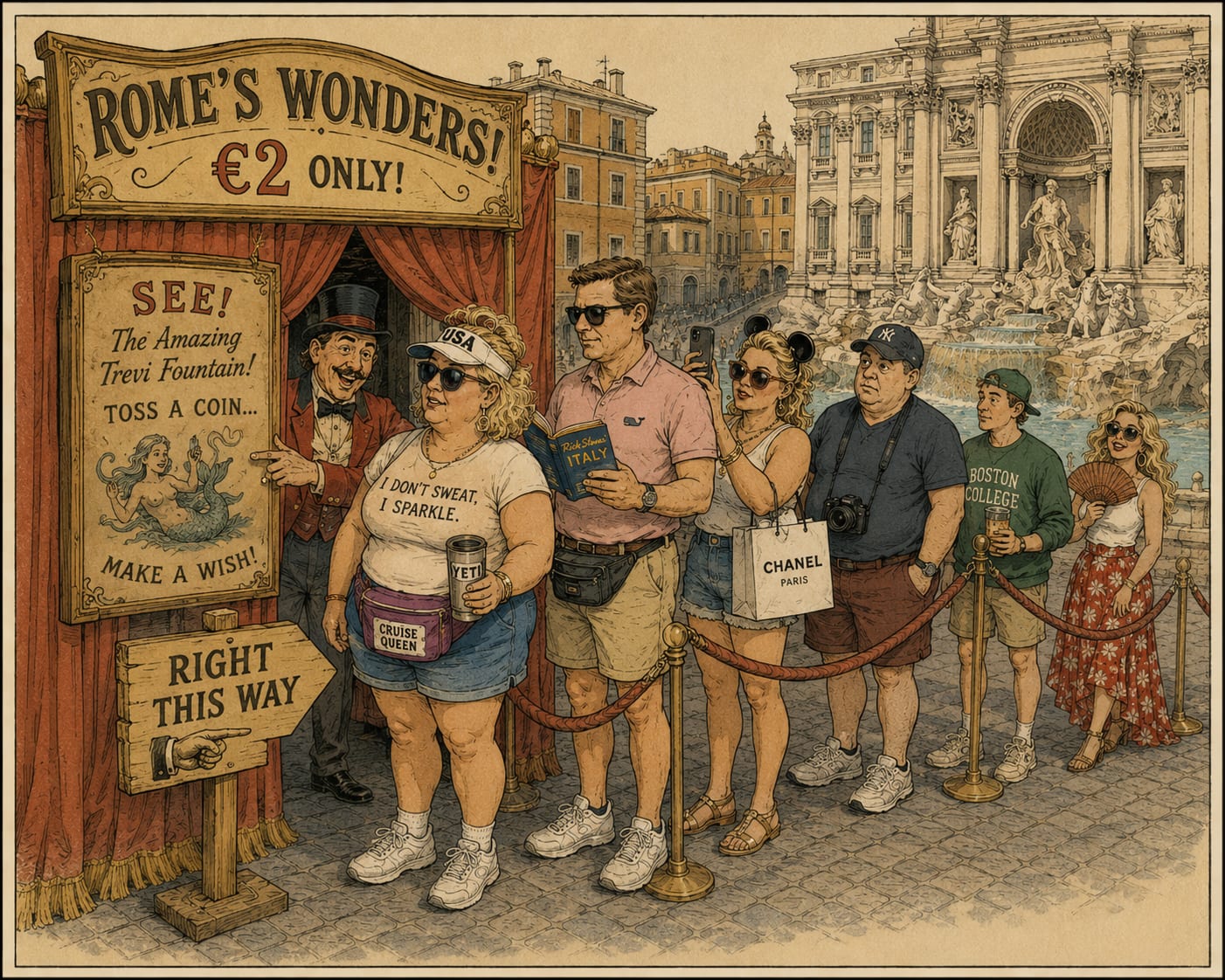
Not the Colosseum. Nor the Vatican Museums. Payment’s expected in those places. But the Trevi Fountain? Tourists are lining up to pay €2 for the privilege of standing shoulder-to-shoulder to toss a coin into the water.
I should have known. The last time I was in the Eternal City I stayed on the Via della Murrate that runs smack into the Trevi. I bunked at the Maalot, a charming luxe hotel, with a good palazzo bone structure (and a bartender who stirred up a terrific gin martini). A stay there felt like fingertips on velvet. The city seemed mine for the asking, until I stepped out on the street.
Rome’s builders, its emperors and popes, never imagined this footsore thicket of humanity, ignoring their great works, eyes cast downward, as their phone’s GPS guided them towards their goal: a glimpse of the Trevi and an elbow in their back from the next arrival. Each day some 30,000 people follow the same route. I fled back to the bar.
It is all too much in a city still absorbing the impact of the 2025 Jubilee year that brought tens of millions of visitors into Rome, pushing tourism to record levels. So to manage the crush the city introduced a €2 admission fee this past February active between 9 AM and 10 PM.
A charge to see a public fountain feels like a small thing. Until you realize it isn’t. It’s Rome’s present and Europe’s future. It’s also something more unsettling.
The crowds are no longer merely annoying. They’re now the defining experience.
In Florence, last year, roughly 365,000 residents shared the city with more than 4.6 million visitors. In Paris, Montmartre residents lament that one of the city’s most beloved neighborhoods (theirs) is becoming “Disney-fied,” its cafés and shops evolving from parts of a living city into props for the global tourism machine. In Venice there are entrance fees and crowd-management systems that would have sounded absurd 20 years ago.
Meanwhile, rising destinations like Dublin are beginning to confront that hard question: How much tourism can a place absorb before it begins changing into something else?
Each city weaves a slightly different thread, but together they tell the same story. Europe’s most famous places increasingly resemble theme parks. But you can’t just blame the Americans. Or the Chinese. Or the Indians. Europe has welcomed travelers for centuries. The problem lies in their concentration. The Trevi Fountain requires crowd controls because everybody wants the same damn selfie at the Trevi Fountain.
And that’s not working: thousands of us are chasing the same places for the same experience on the same day. It’s the assumption there are only 20 European destinations really worth “doing.” There’s the West End. And Paris. Florence, Venice and Rome, of course. Add Barcelona, the Amalfi Coast, Provence and wherever the next season of White Lotus winds up (Spoiler alert: it’s Cannes). Add the year’s hottie destination. Albania! Bingo. You have the same itinerary as everyone else. Everything else becomes Spokane.
My apologies to Spokane. As you'll be reading here shortly, Spokane is an amazing city. Unique, playful and under appreciated. Its sin? It’s an unknown quantity. And with travel so expensive, who dares take a risk of going somewhere obscure? In Europe there are plenty of cities just as unfamiliar. And most all of them are worthy of your consideration.
I can think of a couple right off the bat.
Lecce, in Italy’s deep south, where baroque churches glow the color of honey and evening passeggiatas are still conducted primarily by its residents.
Ljubljana, Slovenia’s compact and improbably civilized Hapsburgian capital, where life unfolds beside a river instead of around a selfie queue.
Gdańsk, Poland’s famed Hanseatic port, back from wartime destruction and somehow still overlooked by the junior-year-abroad crowd rushing between Berlin and Prague.
And in German, a compact jewel of a city named Erfurt, where a food stall operator might hand you a free bratwurst to try because they want you to understand Erfurt’s bratwurst is the best in the country.
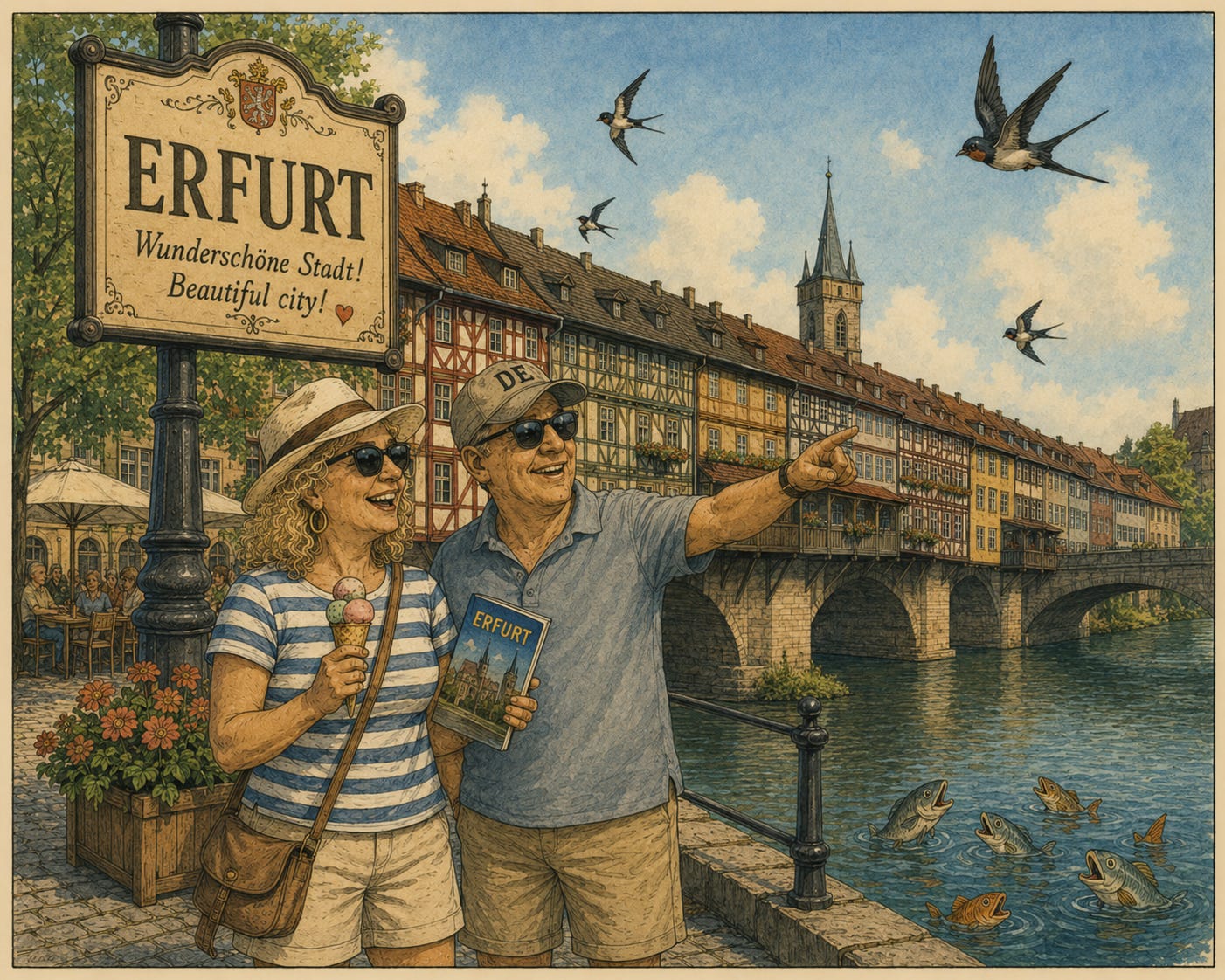
These cities possess something increasingly rare in Europe: Space. Not just physical space. Psychological space. They offer you the ability to wander without a strategy. To encounter rather than consume. Enter a restaurant because it looks interesting, not because it averaged out to four stars from 4,000 online reviews. Sit in the main square and eavesdrop on the locals. Turn off Google Maps. Go get lost.
Americans come to Europe for authenticity then join the longest line to experience its opposite. Don’t do Positano or Lisbon because your neighbors went there. Opt for Erfurt.
“Lost in Place” is about exploring cities that offer surprise, and delight. So if you’re headed to Europe this summer go off-road. Go somewhere you haven’t heard about. I’ll bet you two euros the fountains will be free.
Let me know what you find.
Over to you. The search for an authentic encounter usually begins where the crowds end. If you are heading off-road this summer, or if you have already found a free fountain of your own, you can leave your thoughts below.
Meanwhile if you’re new to “Lost in Place” start with these five stories.
Field Notes
Links to Like:
The Maalot. A playful, 30-room 5-star hotel located in Rome’s historic center. Guest rooms pop with contemporary Italian style. There’s a winter garden restaurant called Don Pasquale, and a cozy cocktail lounge well supplied with dry vermouth. Rates from $742 USD
Trevi Fountain. Rome’s most iconic Baroque masterpiece, built between 1732 and 1762 by Nicola Salvi. Visitors traditionally toss a coin over their shoulder into the waters to ensure a return trip to Rome.
Erfurt. The capital of Thuringia in Germany. The city’s known for its beautifully preserved Old Town. Key highlights include the iconic merchant houses on Krämerbrücke Bridge, the soaring St. Mary's Cathedral, and a rich history connected to Martin Luther.
And here are two more European cities I’ve liked.
###
I think that's exactly right. One of the unintended consequences of social media is that it turns discovery into consumption. A place can go from "hidden gem" to "crowded attraction" in a single season.
I've also found some of my favorite travel memories came from ignoring the lists altogether and simply wandering. The trick, though, is choosing the right place to wander. It's a lot easier to stumble onto something memorable in a city that isn't already overwhelmed by visitors.
That's part of what I'm interested in exploring this summer: not just how to avoid the crowds, but how to find places where serendipity still has room to operate.
"Americans come to Europe for authenticity then join the longest line to experience its opposite."
This line made me pause. I am not American, but I have done the same thing. I have chased the famous fountain, the viral café, the place everyone insisted I "had" to see. In the end, I just felt worn out.
The idea of turning off Google Maps is the real invitation here. It means wandering, getting lost, and choosing a restaurant because it looks interesting, not because 4,000 strangers gave it four stars.
Lecce, Ljubljana, Gdańsk, Erfurt. I have not visited any of these places, but now I want to.
Thank you for reminding us that it is okay to skip the lines.