

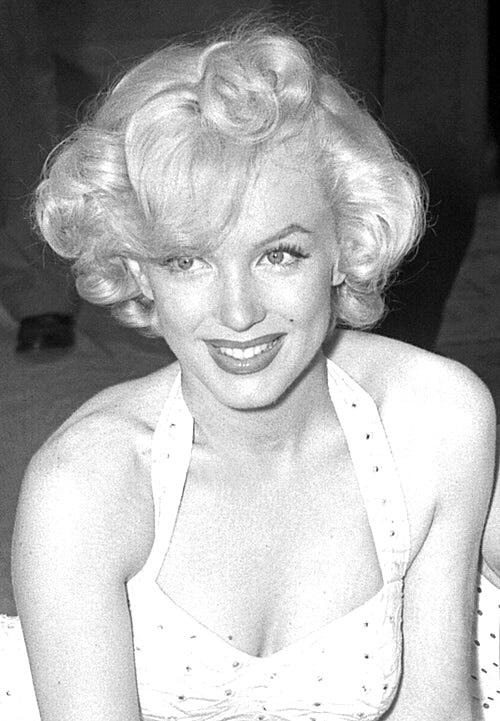
They arrive early, especially in summer when the arid Coachella Valley heat can sear the nasal passages and redden the skin.
The pilgrims enter the grove of palm trees in downtown Palm Springs and stand before a 26-foot-tall Marilyn Monroe. The 17-ton painted stainless steel and aluminum statue Forever Marilyn, by Seward Johnson, freezes the Hollywood icon at the exact moment a whoosh of air from a subway train sends her white dress billowing skyward in the 1955 film The Seven Year Itch.
The tourists pose between her spread legs, giggling, photographing one another, then glancing upward, some with embarrassment, others with wonder.


To the great annoyance of the breeze-block politburo, local elites who prefer their culture high-end and clean-lined like the architectural festival called Modernism Week, the campy statue has become Palm Springs’ iconic symbol, as inseparable from the city as the Statue of Liberty is from New York.
This raises a question.
Visit Palm Springs and you’ll spot Marilyn all over town—from the towering sculpture to souvenir shop t-shirts to AirBnb fridge door magnets. On May 30, 2026—the day before the centennial of her birth—1,034 people of both sexes donned blond wigs and white skirts to gather in the statue’s shadow. They broke a Guinness World Record for so many Marilyns in one place.
No where has embraced Marilyn Monroe more enthusiastically than Palm Springs—far more than LA, the sprawling metropolis where she lived her life.
Why?
It’s not the film actor. That person is long dead.
It's “Marilyn” the persona this city loves—sex and sunshine, glamour and reinvention—the intoxicating feeling that life could be, should be, like the first days of summer vacation.
And that describes Palm Springs, too.
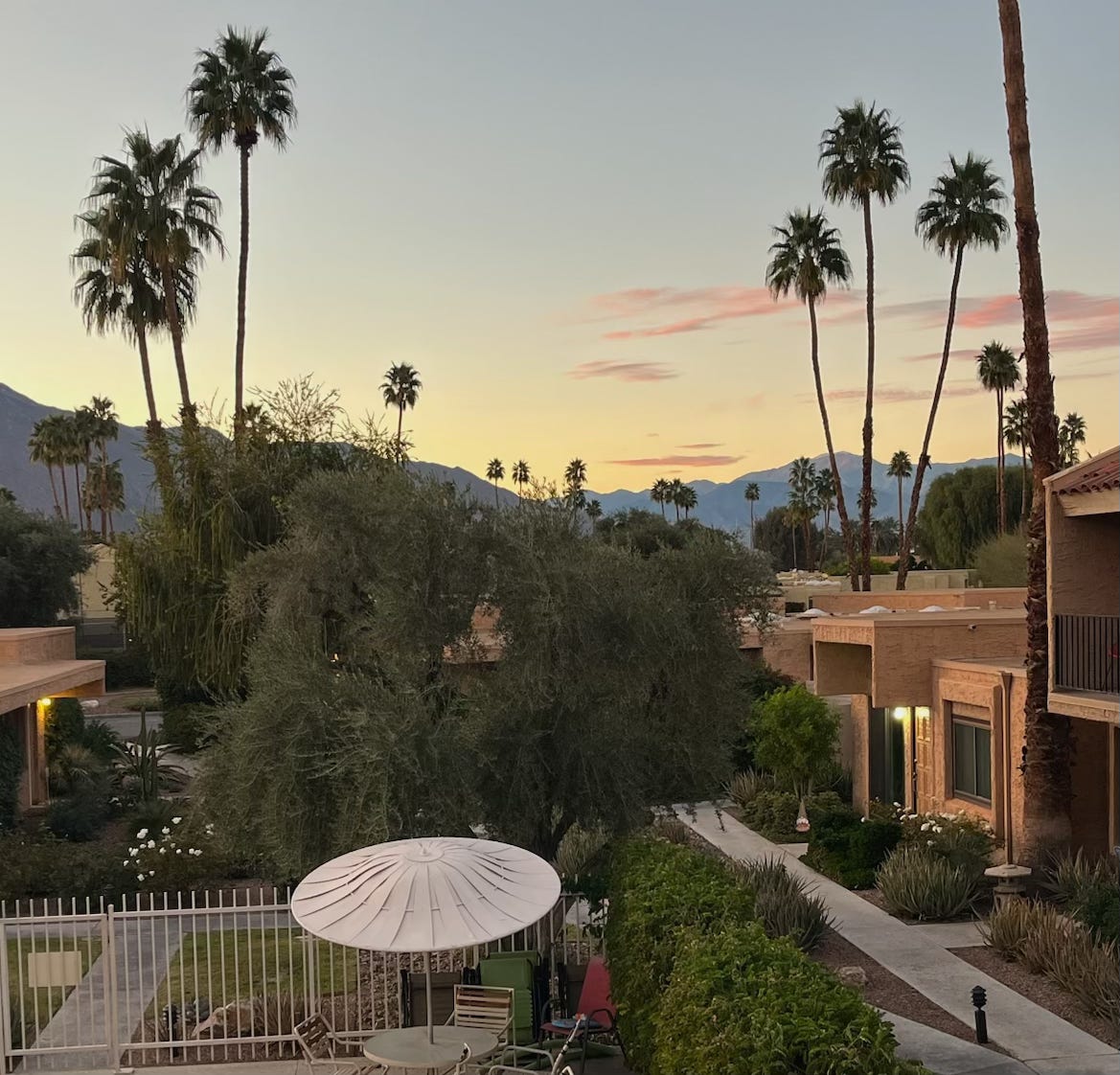
She and Palm Springs grew famous together. Explore the town and much of what you encounter are lovingly preserved symbols of a certain sort of 1960s Space Age optimism: Kidney-shaped pools, cocktail patios, bossa nova on the hi-fi, low-slung modernist roofs, Tiki bars and rosé sunsets. Marilyn slips into the landscape as naturally as a butterfly chair or a Slim Aarons photograph.
She’s just another piece of mid-century design.
A perfect fit.
Except Monroe wasn’t here all that much. She lived and worked in Los Angeles. But it was darker there. Los Angeles was where Norma Jean became Marilyn, where Hollywood created her and consumed the woman underneath. Success brought exhaustion. Fame brought disappointment. Then barbiturates, and on August 4, 1962, a fatal overdose. They buried her in Westwood. LA mourned, then moved on.
A growing city had bigger fish to fry.
In Palm Springs, her legend only grew. Like George Washington, Marilyn slept everywhere. She drank here. Ate there. Checked in at this hotel. Trysted with JFK at that one. (A documented Kennedy hook-up happened—but in Palm Desert, not Palm Springs.)
Evidence of her time here, however, is surprisingly thin, and the facts tend to be as ephemeral as her boop-boop-de-doop whisper. Realtors, for example, connect her to all sorts of houses in Palm Springs, including one on Rose Avenue she supposedly owned. It’s good for business.
But it’s mostly bunk.
Little can be certain save for paparazzi photos and gossip column mentions.
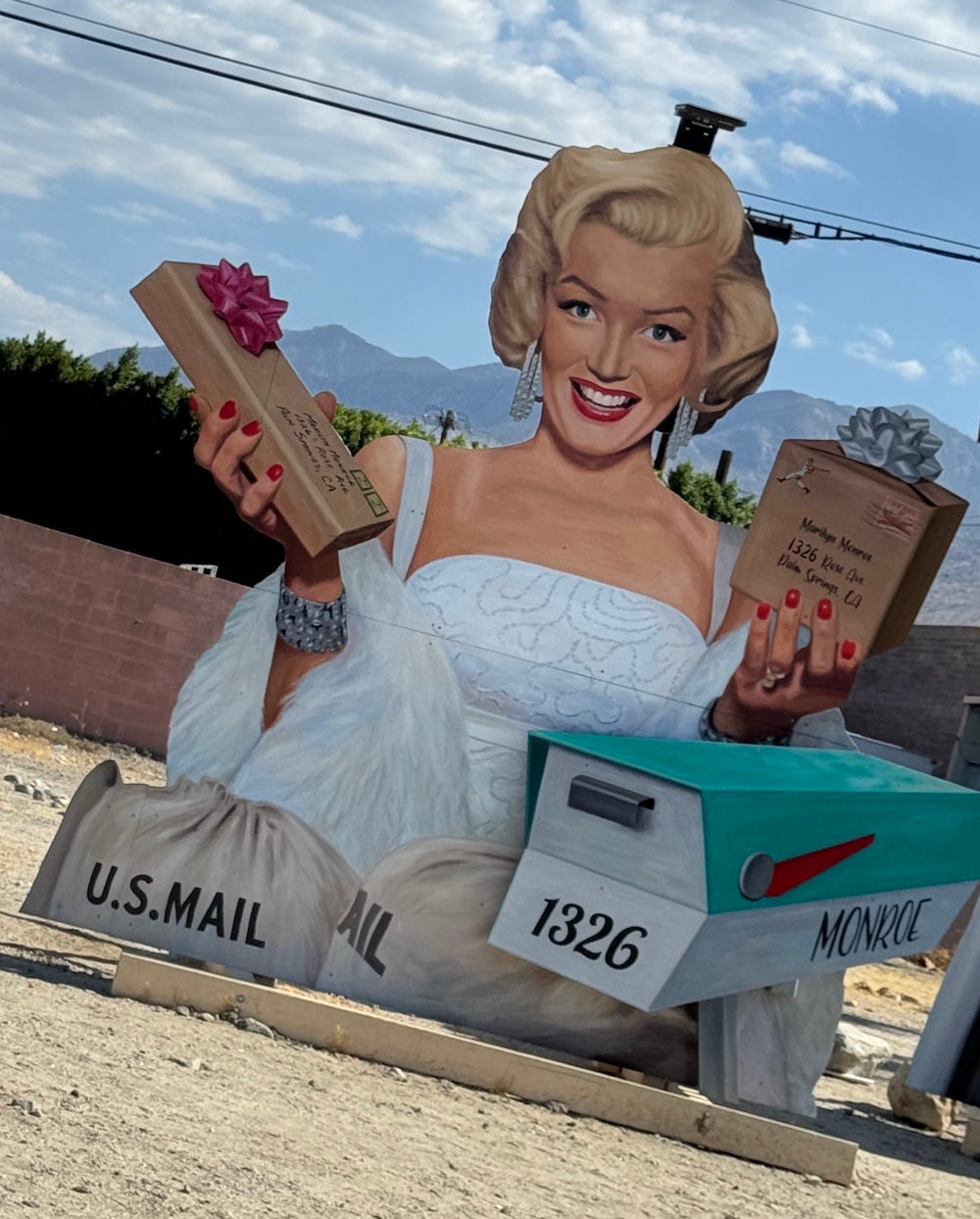


Marilyn pops up everywhere in Palm Springs, but if you want to go looking for the actual places Monroe played and stayed, those are a precious few. I can tell you two for certain:
The Racquet Club, 2743 N. Indian Canyon Drive. This is Ground Zero for the Palm Springs - Monroe connection. In 1949, the Racquet Club just north of Vista Chino Blvd was the place to see and be seen. Charlie Farrell’s playground wasn’t merely a tennis club. It was Hollywood in the desert. Lucille Ball, Bing Crosby, Ava Gardner and Frank Sinatra all came. Bob Hope was practically furniture. They would wander the grounds in swim suits. Studio executives held court beneath striped umbrellas, and the pool boys remembered everyone’s drink before they ordered it.
Also here an unknown 23-year-old contract player.
Photographer Bruno Bernard—better known as Bernard of Hollywood—had brought her to the club for a publicity shoot around the swimming pool. The photos show Monroe on a diving board in cork wedgies wearing a cornflower blue two-piece suit desperately hoping Hollywood would notice.
It did.
The William Morris Agency’s Johnny Hyde, one of the industry’s most influential agents was also at the pool. Whether this was their first meeting or merely the one where their relationship deepened is still debated, but historians agree that after this Palm Springs weekend, Hyde became Marilyn’s fiercest champion. He negotiated better contracts, got her better roles. He persuaded skeptical studio executives Monroe was more than another empty-calorie blond. Within a year she appeared in The Asphalt Jungle and All About Eve. Soon after came a new Twentieth Century-Fox contract.
Palm Springs changed Monroe’s life.
They should have put up a plaque, but the Racquet Club closed years ago. Fire consumed most of the property in 2014. Today it’s fenced off, no access allowed, awaiting redevelopment. The pool is drained and filled with dirt. But this is where the world’s most famous sex symbol began her rise.


The Rendezvous Hotel, 1420 N. Indian Canyon Drive. Before it was the Rendezvous Hotel, this modest one-story three-star operated as the Mira Loma Hotel, one of Palm Springs’ smaller hideaways. It wasn’t the grandest resort in town. That was the point.
Marilyn returned here repeatedly in the early 1950s, slipping away from Los Angeles for weekends when Palm Springs was still less than a two-hour escape from the studios. It was no hideout. Palm Springs wasn’t built for anonymity. But compared with Hollywood, the desert allowed celebrities an opportunity to linger by a pool without feeling every movement was another publicity photograph. Escape. That’s what the Mira Loma was for.
She routinely booked the far southeast corner room because it offered maximum privacy. It sits in the original 1930s part of the building. The Rendezvous reimagined it as the Pretty in Pink suite, decorating it in pink accents, vintage memorabilia and photos of her.
What makes it interesting isn’t simply that Marilyn slept there. It’s that guests could still walk through essentially the same courtyard and feel the same twilight winds rustling the palms. The hotel is closed for renovations, and scheduled to reopen in late 2026 under a new name: The Pink Palm Inn.
The new owners say Marilyn’s old room will stay pink.
There’s something fitting about that. Palm Springs never tried to outgrow Marilyn Monroe. It has simply folded her into the landscape, along with the mountains, the lemon-colored sun and cool turquoise pools, and the geometric lines of its Mid-Century architecture. In a town built on curating its visual heritage, past performance is a guarantee of future results. They’re like diamonds.
And diamonds are both forever and a girl’s best friend.
Have you visited the Forever Marilyn statue ? Is it an eyesore or is it an appropriate symbol of Palm Springs? Have your say below.
Other American icons:
Correction: The gathering of the 1000 Marilyns took place on May 30, 2026, not May 31.
###